I build AI applications, and I spend most of my effort on the part that looks
correct and is and isn't.
Most recently: tracepath, a
RAG command-line tool that answers questions about a project's decisions from its specs and
decision records, with every citation checked in code. Before that I built JobHunt, a multi-user
job search platform where 15 of 16 authored ground-truth pairs landed in their expected band,
and decision-memory, a cited RAG system that publishes its own
wrong-answer rate. I work across React, Next.js, Vue, and Django.
About
I have a Master's in Computer Engineering from Georgia Tech and have built full-stack web
applications with Vue.js, React, JavaScript, and Django across internship, contract, and research
roles. Over the past year I've put that into AI applications, and into classical ML in
classification and regression.
A check that passes is a claim, not a proof. A validation split can score beautifully, a webhook
can succeed twice, a model can answer confidently on no evidence, and nothing flags any of it.
Those are the bugs I care about.
Skills
Python · SQL · Structured LLM outputs ·
Prompt engineering · RAG · LLM evaluation · Cross-validation · Vue.js · Django · AWS · Firebase · NoSQL · Scrum
/ Agile
Stack
JavaScript · TypeScript · Python · React · Next.js · Tailwind ·
CSS3 · HTML5 · scikit-learn · pandas · NumPy · Neo4j
Work experience
Software Engineer
B-Line Express · Remote
May - Aug 2023
- Integrated Google PaLM into a production email platform so non-profit clients could
auto-draft campaign content.
- Built and maintained core features of a mass-emailing SaaS product in Vue.js,
JavaScript, and ColdFusion, including a customizable template system that let clients
launch branded campaigns without engineering help.
Software Engineer, Enterprise Data Management
Moody's Analytics · Remote
Jun - Aug 2022
- Worked in a Scrum environment with designers and backend developers to translate client
requirements into technical specifications.
- Queried and analyzed large-scale datasets in AWS Athena to design QA dashboards that
checked data integrity before client delivery.
- Authored technical documentation and process-flow diagrams for a suite of Python
scripts, giving business users a self-service reference.
Graduate Research Assistant
Georgia Institute of Technology · Atlanta, GA
Jan 2021 - May 2022
- Took over frontend development on a Bluetooth Low Energy IoT platform (GAMMA Research
Group / Center for Distributed Energy) that monitors grid equipment: voltage,
temperature and power. Built the React features for live device data and dataset export.
- Integrated the React frontend with a Firebase (NoSQL) backend on Google Cloud so device
telemetry reached the application.
Additional experience
Sales AssociateLA FitnessMar 2025 - Jul
2026
Sales AssociateT-Mobile
(GP Mobile)Jun 2024 - Aug 2024
Education
M.S. Computer Engineering
Georgia Institute of Technology
2021 - 2022
B.S. Computer Science
ESIH, Port-au-Prince, Haiti
2015 - 2019
Latest work
tracepath
Python · Neo4j · Claude API · RAG
A RAG command-line tool that answers questions about a project's decisions from its specs and
decision records. An LLM
extracts each spec into typed, cited items in a Neo4j graph. Every answer cites those items,
with each citation checked in code against the items the model was
sent. Every paid call is checked against a cost ceiling before it is made.
My first design walked links between documents and answered 1 of 5
eval questions, so I measured why, rebuilt it around retrieval plus one checked
model call, and froze the prompt before running questions it had never seen. On all nine
questions, the five eval ones plus four held out, my earlier tool,
decision-memory, abstained on every one; tracepath gave an answer on all nine.
That compares two whole systems on different models and different inputs (decision-memory
reads only each spec's index.md and rationale.md), so it is not a verdict on graphs versus
vector search.
8/9
questions answered right, 1 partly · expected answers written
before the run, judged by me, 4 held out
10/10
unanswerable questions declined, 0 invented answers ·
questions written and marked by me
18
logged experiments · several with predictions or decision rules
committed before results
1,229
tests passing · integration against real Neo4j
JobHunt
Next.js · TypeScript · Postgres (Supabase) · Row-Level
Security
A multi-user job search platform, built from the stack decision onward. OAuth sign-in
through Google and GitHub, real-time search against the Adzuna
API, and application tracking, backed by a Postgres schema with
row-level security enforced on every table. Every account's usage is metered by
an atomic gate that holds exactly at its limit under real concurrent load: with 15 accounts against a cap of 5, it let exactly 5 through and
none slipped past. GitHub Actions runs lint, type checks, and unit and integration
tests against a real local database stack on every pull request, and applies schema
migrations on merge.
I tested the failure handling by breaking things on purpose. In
development, a forced-failure chain confirmed a Sentry alert reaches a delivered
email. A rollback drill, run early on the
scaffold homepage, broke the live production site and restored it by promoting the
previous build.
It scores real listings against a user's profile through GPT-5.6 Luna in production, with
a deterministic filter that drops any skill the model invents but
the caller doesn't actually have. I built an eval harness and measured whether the
scoring holds up instead of assuming it: of 16 authored ground-truth pairs, 15 landed in their expected band. The ground truth was authored
from the same rubric the scorer reads, so this measures consistency with that written
definition, not independently validated real-world accuracy. That is
the honest scope of what a first-version internal eval can prove. One of the
sixteen was corrected after review, a wrong expected answer in the test data itself, not a
change to how the model scores. The 15 of 16 is from the run before that correction; I haven't
rerun the full set since. The remaining miss traced back to a specific, repeatable gap in the rubric's calibration, and I
flagged it for the next revision rather than writing it off as noise.
15/16
eval pairs in the expected band · measures rubric consistency,
not real-world accuracy
1,840
tests passing in CI · 1,580 unit, 260 integration against a
local database stack
Every table
row-level security enforced · multi-tenant from day one
5 of 15
accounts admitted when 15 hit a cap of 5 at once · none slipped
past
decision-memory
Python · RAG · Clean Architecture · LLM
A locally indexed, cited RAG system that makes software decision history queryable. When the evidence
doesn't support an answer it says so instead of inventing one, and the README documents the rate at which it still answers wrong.
A per-sub-claim verification layer runs exact containment checks and LLM verification, then
drops any sentence its cited evidence doesn't support. I've paused development.
264
conformance checks · 2 adapters · 0 failures
4
layers · no external imports in domain · mypy + Ruff
The conformance suite fails any adapter that emits a confident record
from malformed, empty, or invalid-UTF-8 files. A live evaluation harness runs the system against a real corpus, checks
whether it answers or abstains as expected and cites the required records, and reports its
failures openly.
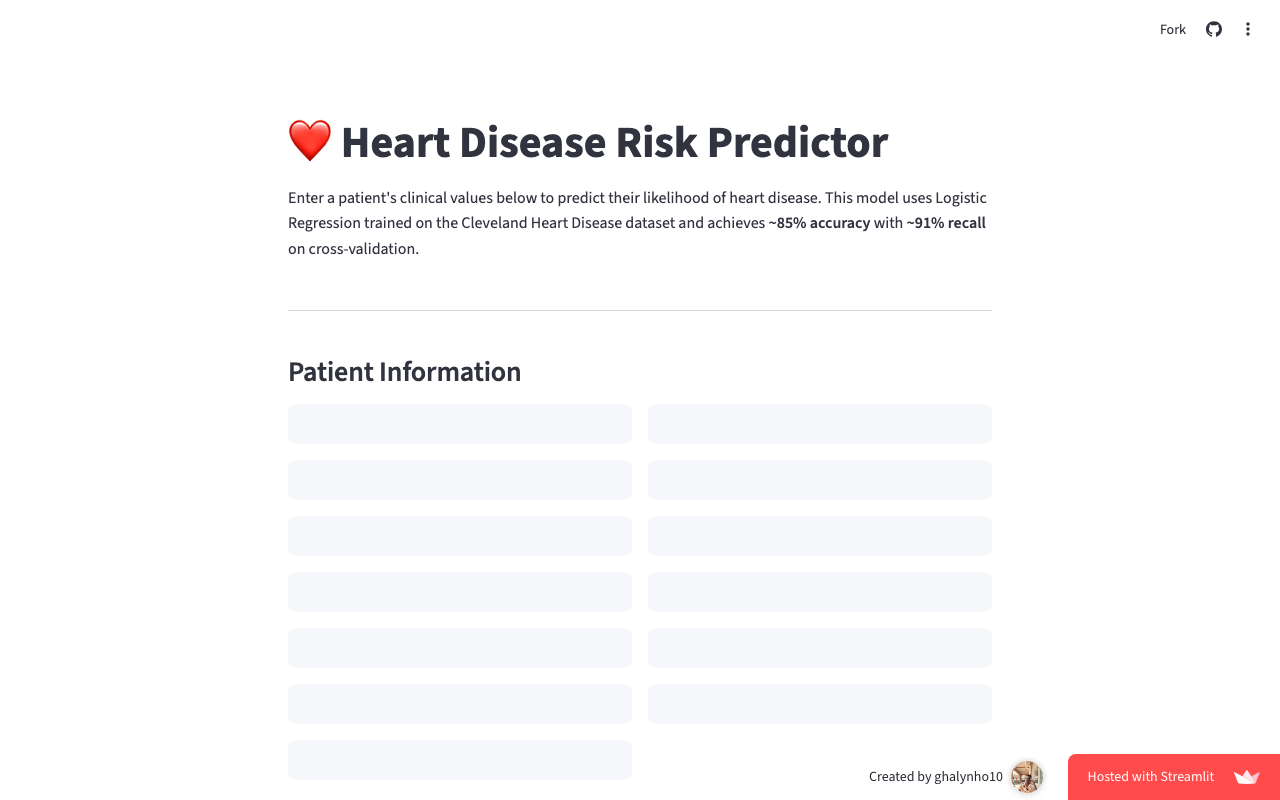
Heart Disease Risk Predictor
Python · scikit-learn · Streamlit
Compared Logistic Regression, KNN, and Random Forest on clinical
patient data, then picked the model that trades overall accuracy (~85%) for higher recall (~91%). In a screening context,
missing a high-risk patient costs more than a false alarm, so recall was the metric
worth optimizing.
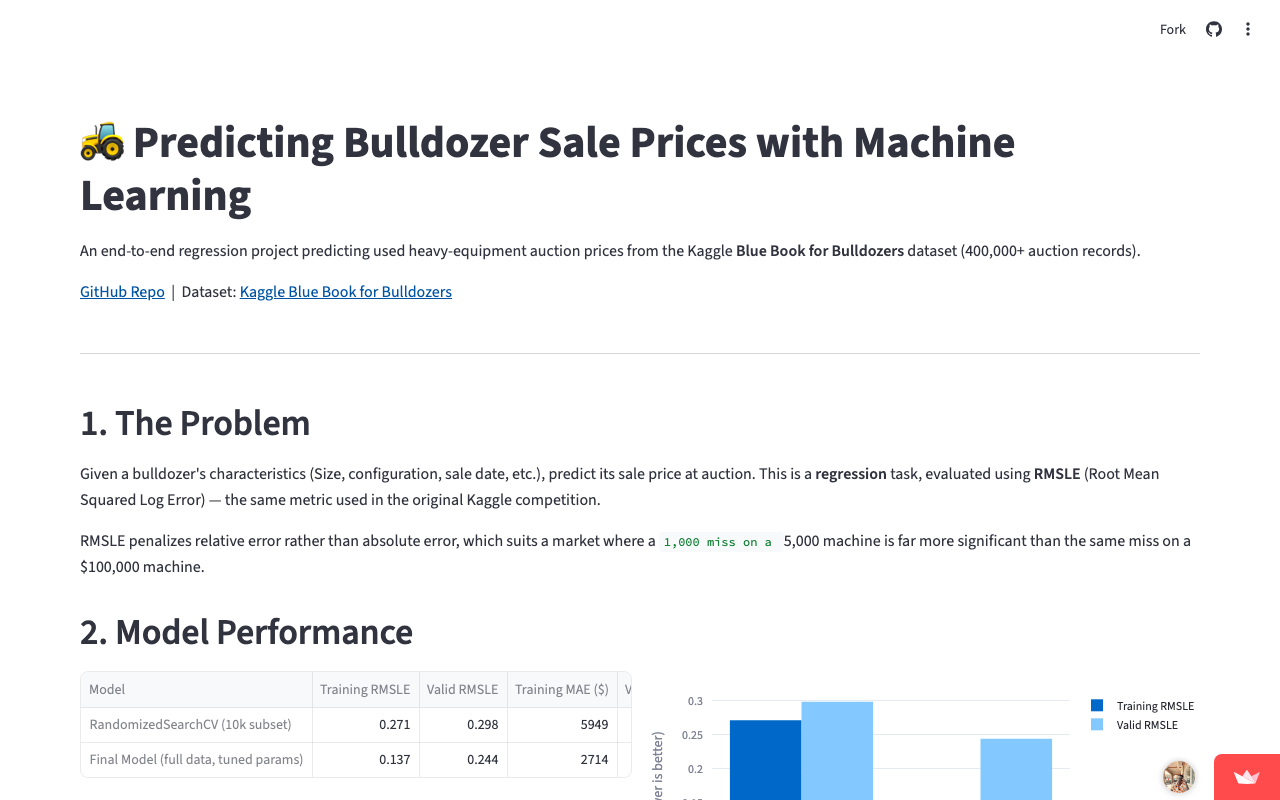
Bulldozer Sale Price Predictor
Python · scikit-learn · regression · Streamlit
Predicts used heavy-equipment auction prices from over 400,000
historical sales. A RandomForestRegressor reached 0.244
validation RMSLE after two-stage tuning, with time-series feature engineering
and error analysis broken out by equipment category.